
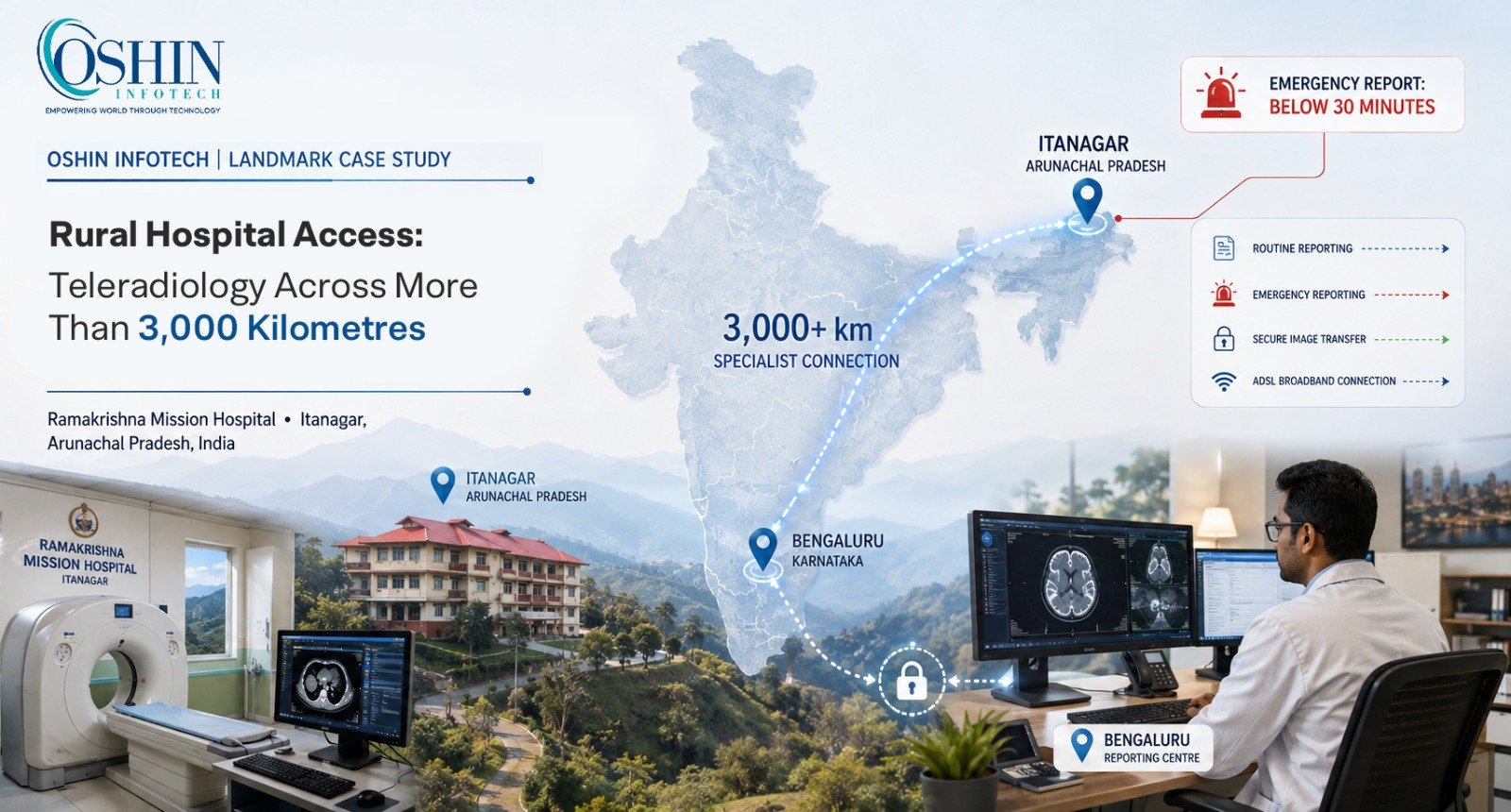
VISUAL BRIEF
Hero Visual Direction
A map-led visual connecting Itanagar, Arunachal Pradesh, with Bengaluru, Karnataka.
✓ Rural hospital and CT scanner at the originating site
✓ Secure image-transfer pathway across India
✓ Remote radiologist workstation in Bengaluru
✓ ADSL and secure file-transfer indicators
✓ Routine and emergency reporting routes
✓ “3,000+ km specialist connection” callout
✓ “Emergency report: below 30 minutes” callout
The Challenge
Ramakrishna Mission Hospital served as a referral hospital for Arunachal Pradesh, a predominantly mountainous and geographically difficult-to-access region.
The hospital had the state’s only CT scanner and one qualified radiologist. High imaging volumes—particularly CT examinations—created a workload that could not always be managed by the limited on-site reporting capacity.
The organisation needed a practical way to:
✓ Extend the capacity of the on-site radiologist
✓ Obtain interpretations without transferring patients long distances
✓ Prioritise emergency CT examinations
✓ Transmit studies despite limited local infrastructure
✓ Provide relevant patient information with every case
✓ Maintain an affordable model for a charitable hospital
The challenge was not simply connecting two computers. The workflow had to move clinically usable images, patient details and completed reports reliably between a remote hospital and radiologists located more than 3,000 kilometres away.
The Teleradiology Model
A low-cost remote reporting workflow was established between Ramakrishna Mission Hospital and a commercial teleradiology provider in Bengaluru.
Remote Infrastructure Configuration A computer at the hospital was configured remotely. The technical team in Bengaluru used remote-access software to establish settings and provide ongoing system maintenance. |
Secure Image Transmission CT images were transferred through an ADSL broadband connection using secure file-transfer protocol. The workflow demonstrated that specialist reporting did not necessarily require sophisticated high-bandwidth infrastructure to become operational in a remote setting. |
RIS-Supported Patient Information Relevant clinical and demographic information was entered into a radiology information system for each transmitted examination. This allowed the remote radiologist to receive the contextual information required to interpret the study. |
Trained On-Site Radiographers Local radiographers were trained to prepare and transmit CT studies and supporting patient information through the agreed workflow. |
DIVISION OF RESPONSIBILITIES
• Images were acquired locally
• Studies were prepared and uploaded locally
• Interpretation was completed remotely
• Reports were returned to the hospital
Routine CT Reporting Non-emergency examinations entered the standard reporting workflow. The average turnaround time after receipt in Bengaluru was six hours. |
Emergency Prioritisation Cases classified as emergencies were handled through a faster pathway. Thirty-two emergency studies were reported during the evaluated period, with preliminary reports consistently available in under 30 minutes. |
Remote Technical Maintenance Computer maintenance—including antivirus scanning, system adjustments and cache management—was performed remotely from Bengaluru. This reduced the need for continuous on-site technical support. |
Charitable Reporting Arrangement Because the hospital provided free or low-cost treatment to rural patients, the remote reporting service was delivered without a reporting charge during the documented programme. |
Project Statistics
| MEASURE | DOCUMENTED RESULT |
|---|---|
| Distance between hospital and reporting centre | More than 3,000 km |
| Evaluation period | 12 months |
| Total studies transmitted | 962 |
| Imaging modality | CT |
| Emergency studies | 32 |
| Average non-emergency turnaround | 6 hours |
| Emergency turnaround | Consistently below 30 minutes |
| Initial transmission failures | 180 studies |
| Initial transmission-failure rate | 19% |
| Studies eventually retransmitted | All affected studies |
The initial transmission difficulties are significant because they show that early operational problems did not make the model unworkable. All initially failed transmissions were subsequently sent successfully.
Technology and Workflow
✓ CT imaging
✓ Radiology information system
✓ ADSL broadband connection
✓ Secure file-transfer protocol
✓ Compressed image files
✓ Remote-access software
✓ Clinical and demographic data entry
✓ Remote workstation maintenance
✓ Routine and emergency case classification
Published study Teleradiology in an Inaccessible Area of Northern India — Journal of Telemedicine and Telecare, 2010; 16(3):110–113. DOI: 10.1258/jtt.2009.009007 |
“Remote implementation of teleradiology is possible in rural India.” — Conclusion reported by the study authors |
| DISCUSS A RURAL TELERADIOLOGY MODEL |
| VIEW THE PUBLISHED STUDY |
Key Outcomes
962 CT studies reported remotely | Below 30 minutes Emergency reporting turnaround |
6 hours Average routine reporting turnaround | 3,000+ km Distance bridged through technology |
962 CT studies reported remotely
The hospital transmitted 962 CT studies during the first 12 months of evaluated operation.
Emergency reporting below 30 minutes
Emergency cases consistently received preliminary reports within 30 minutes.
Six-hour routine turnaround
Non-emergency reports reached the hospital an average of six hours after the images were received in Bengaluru.
A 3,000+ kilometre specialist connection
The reporting model connected a remote hospital in Arunachal Pradesh with radiologists based in Bengaluru.
Implementation Timeline
The study documents the implementation sequence but does not provide exact durations for every phase.
| Phase 1 | Workflow Assessment The hospital’s CT workload, reporting limitations, available computer infrastructure and connectivity requirements were reviewed. |
| Phase 2 | Remote Technical Setup Access to a hospital computer was established and the required configuration was completed remotely from Bengaluru. |
| Phase 3 | Staff Preparation On-site radiographers were prepared to transmit DICOM images and enter relevant clinical and demographic details. |
| Phase 4 | Secure Transmission Workflow A process using ADSL connectivity and secure file transfer was established for sending studies to the remote reporting centre. |
| August 2007 | Evaluated Service Begins The 12-month period reported in the study commenced. |
| First 12 Months | Routine Operations A total of 962 CT examinations were transmitted and reported. Routine and emergency studies followed separate turnaround expectations. |
| Operational Review | Feasibility Assessment The programme assessed report turnaround, transmission reliability and the feasibility of maintaining remote radiology support in a difficult-to-access region. |
Access and Clinical Impact
Specialist Access Across 3,000+ km
The project allowed a rural referral hospital to access additional radiology capacity without requiring the reporting radiologist to be physically present.
Emergency Reporting Continuity
The priority workflow delivered preliminary emergency reports in under 30 minutes across the documented emergency cases.
Support for Next-Day Clinical Review
The paper noted that the six-hour routine turnaround allowed patients to return to their clinician with the report by the following day.
Reduced Dependence on Local Availability
Remote reporting supplemented the hospital’s limited on-site radiology resources and helped share the CT workload.
Demonstrated Low-Infrastructure Feasibility
The project operated using ADSL broadband, secure file transfer, remote-access software and trained local staff rather than relying on an elaborate dedicated network.
Social-Impact Delivery Model
Remote interpretation was provided without charge because the hospital was a charitable institution serving rural patients through free or low-cost care.
Evidence boundary The publication reported feasibility, study volume and turnaround performance. It did not publish figures for financial savings, return on investment, mortality reduction, diagnostic-accuracy improvement or patient-transfer reduction. Those outcomes should not be attributed to this case without additional evidence. |
Why This Case Became a Landmark
The project demonstrated that a rural healthcare organisation could build a functioning teleradiology workflow despite geographic isolation, limited specialist availability and modest connectivity.
Infrastructure Can Be Proportionate A workable remote-reporting model can be designed around available connectivity rather than waiting for ideal infrastructure. |
Local Staff Are Central to Success Technology alone does not move a case through the workflow. Trained on-site personnel must acquire, prepare and transmit images with accurate patient information. |
Emergency Cases Need a Separate Pathway The contrast between six-hour routine reporting and sub-30-minute emergency reporting shows the importance of explicit prioritisation. |
Technical Failures Require Recovery Processes Nineteen per cent of studies initially experienced transmission failure, but every affected study was subsequently retransmitted. Resilience and issue resolution were therefore as important as the initial connection. |
Applying the Lessons Today
✓ Secure DICOM-based image transmission
✓ PACS and RIS integration
✓ Verified patient and clinical information
✓ Routine, priority and emergency classifications
✓ Defined turnaround-time expectations
✓ Real-time case-status visibility
✓ Transmission-failure alerts and recovery processes
✓ Access controls and audit trails
✓ Reliable communication with local clinicians
✓ Remote onboarding and technical assistance
✓ Contingency connectivity where practical
✓ Ongoing quality review

