
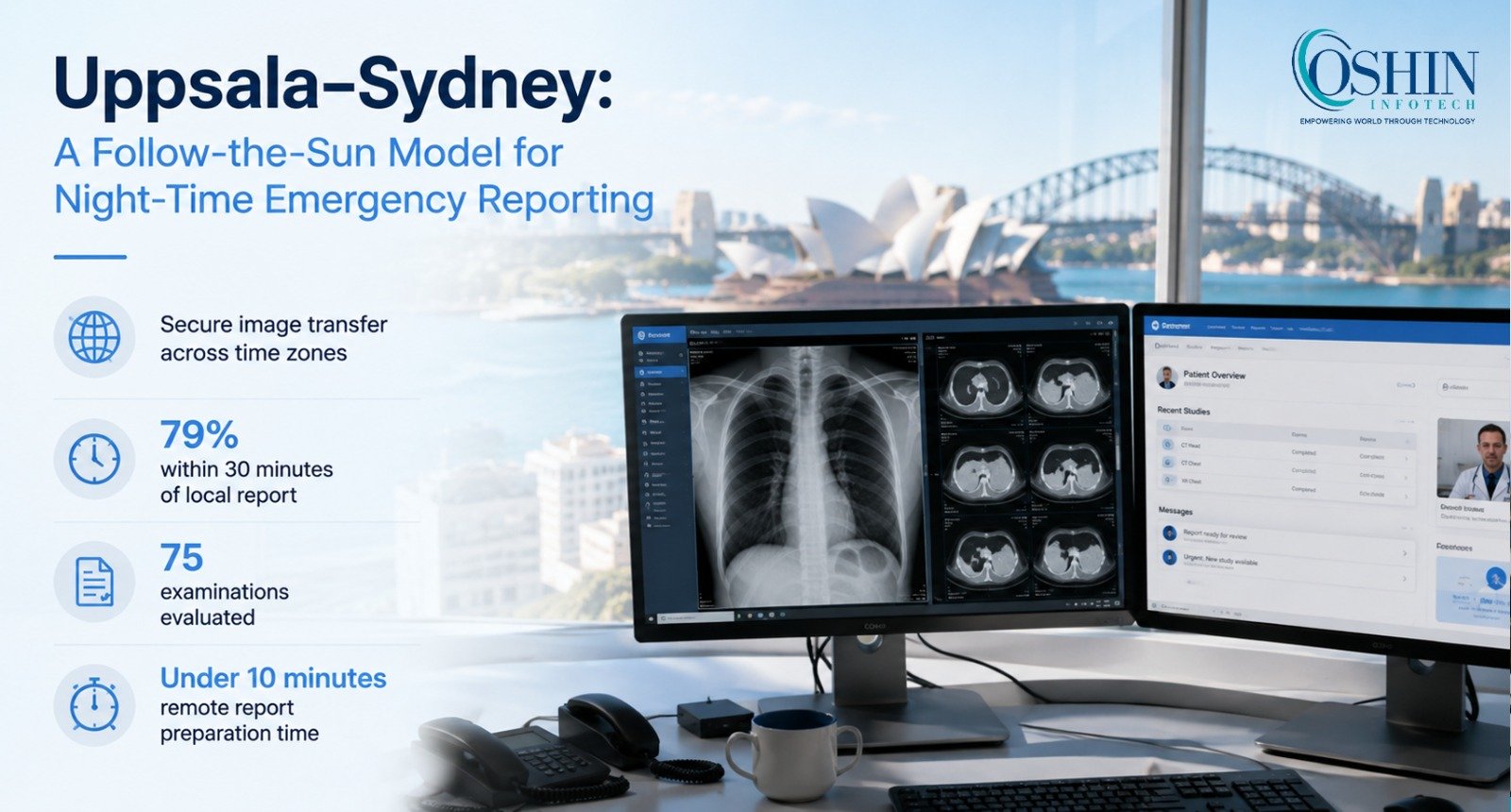
The Challenge
Emergency radiology departments require reporting support throughout the night, but overnight work can place pressure on radiologists, staffing schedules and hospital resources.
The Uppsala team examined whether night-time studies could be interpreted by a radiologist working normal daytime hours in another time zone. The proposed model had to move radiological images from Sweden to Australia and return a usable report quickly enough to remain relevant to emergency care.
The evaluation needed to determine whether the workflow could:
✓ Transfer emergency imaging studies over the internet
✓ Support interpretation from another continent
✓ Return reports without substantial delay
✓ Handle both conventional radiography and CT examinations
✓ Reduce dependence on night-time reporting shifts
✓ Maintain access to an active and alert radiologist
✓ Identify technical limitations affecting turnaround time
Critical operational question The principal uncertainty was not whether a radiologist in Sydney could interpret the images. It was whether the examinations—particularly larger CT datasets—could be transferred rapidly enough for emergency use. |
THE MODEL
The Teleradiology Model
The evaluation connected the radiology department in Uppsala with a radiologist based in Sydney. Because of the time-zone difference, examinations performed at night in Sweden could be reviewed during daytime working hours in Australia.
Follow-the-Sun Reporting The central concept was to move the reporting workload rather than require every interpretation to be completed by a radiologist working overnight. Night-time examinations in Uppsala were reviewed during local daytime hours in Sydney. | Parallel Reporting Evaluation During a one-week evaluation in spring 2005, 75 examinations were interpreted both in Sydney and at Akademiska Hospital in Uppsala, allowing remote and local report availability to be compared. |
Cross-Continental Image Transfer Digital examinations were transferred from Sweden to Australia over the internet. The researchers recorded download time for 75 examinations and report-return time for 24 reports. | Conventional Radiography Transfer All conventional radiological examinations were downloaded in less than 60 minutes, showing more consistent performance for smaller imaging datasets. |
CT Dataset Transfer Large CT studies created the greatest technical challenge. Among CT examinations containing more than 65 images, only 44% completed downloading within 60 minutes. | Remote Interpretation Once the images were available, the Sydney radiologist completed reports in under 10 minutes. Most remote-pathway delay therefore came from image transfer rather than interpretation. |
Report Return and Comparison The Sydney report was available in Uppsala within 30 minutes of the in-house report in 79% of evaluated examinations. | Faster Than Local in Some Cases According to Uppsala University’s account, 17% of Sydney reports were completed before the report produced locally in Uppsala. |
DOCUMENTED EVIDENCE
Project Statistics
| MEASURE | DOCUMENTED RESULT |
|---|---|
| Originating location | Uppsala, Sweden |
| Reporting location | Sydney, Australia |
| Examinations evaluated | 75 |
| Report-return times recorded | 24 reports |
| Evaluation duration | One week |
| Conventional studies downloaded within 60 minutes | 100% |
| Large CT studies downloaded within 60 minutes | 44% |
| Remote report preparation time | Under 10 minutes |
| Sydney reports available within 30 minutes of local reports | 79% |
| Sydney reports completed before local reports | 17% |
What the numbers reveal The results distinguish reporting time from transmission time. Once an examination had downloaded, the Sydney radiologist could complete the interpretation quickly. Large image datasets were the main obstacle to a faster end-to-end workflow. |
SYSTEM DESIGN
Technology and Workflow
| ✓ Digital radiology examinations | ✓ Cross-time-zone reporting |
| ✓ Internet-based image transfer | ✓ Parallel local and remote interpretation |
| ✓ Conventional radiography transmission | ✓ Download-time measurement |
| ✓ CT image transmission | ✓ Report-return-time comparison |
| ✓ Remote radiologist workstation | ✓ Emergency radiology workflow evaluation |
PUBLISHED STUDY Title: Teleradiology Uppsala–Sydney for Nighttime Emergencies: Preliminary Experience Journal: Acta Radiologica Publication year: 2007 Volume and issue: 48(8) Pages: 851–853 Authors: H. Eklöf, E. Radecka and P. Liss DOI: 10.1080/02841850701422120 View the PubMed record • View the Uppsala University summary |
STUDY CONCLUSION
What the Evaluation Established
The evaluation found that cross-time-zone emergency reporting was operationally feasible, but the speed of transferring large image volumes remained the main technical constraint.
The case demonstrated that interpretation could be completed rapidly once the examination reached the remote radiologist. It also showed that the performance of the entire teleradiology service depended on transmission infrastructure as much as radiologist availability.
| DISCUSS A FOLLOW-THE-SUN REPORTING MODEL | VIEW THE PUBLISHED STUDY |
MEASURABLE RESULTS
Key Outcomes
79% Remote reports delivered within 30 minutes of the local report In most evaluated examinations, the Sydney report was available in Uppsala no more than 30 minutes after the locally prepared report. | Under 10 Minutes Remote report preparation time After the images became available, the Sydney radiologist completed the interpretation and report in less than 10 minutes. |
17% Sydney reports completed before local reports Some reports prepared in Australia were available before those produced at the originating hospital. | 44% Large CT studies downloaded within 60 minutes Only 44% of CT examinations with more than 65 images completed downloading within an hour, identifying large datasets as the main bottleneck. |
IMPLEMENTATION
Implementation Timeline
The study documents the sequence and one-week pilot, but it does not provide exact durations for every preparatory phase.
| Phase 1 — Cross-Time-Zone Concept | The team identified the opportunity to use the time difference between Sweden and Australia so that night-time emergency examinations in Uppsala could be interpreted during daytime hours in Sydney. |
| Phase 2 — Technical Workflow Preparation | A digital image-transfer and remote-reporting process was arranged. The evaluation was designed to measure image-download time, report preparation time and the difference between remote and local report availability. |
| Spring 2005 — One-Week Pilot | During one week, 75 examinations were interpreted both in Sydney and at the hospital in Uppsala. |
| Image-Transfer Assessment | The team compared transfer performance across conventional radiology and CT examinations, finding that large CT datasets required substantially more time to download. |
| Reporting-Time Assessment | Investigators measured the time required to complete and return remote reports and compared their availability with local reports. |
| October 2007 — Publication | The results were published in Acta Radiologica as a preliminary evaluation of Uppsala–Sydney emergency teleradiology. |
SIGNIFICANCE
Operational and Clinical Significance
Daytime Expertise for Night-Time Demand The case showed how a hospital could potentially obtain overnight reporting from a radiologist working ordinary daytime hours in another part of the world. This approach later became widely described as a follow-the-sun or time-zone-based reporting model. | Fast Interpretation After Image Availability The under-10-minute report preparation time demonstrated that the reporting component could be efficient once the radiologist had access to the complete examination. |
Potentially Reduced Night-Shift Pressure The study was motivated partly by the possibility of improving radiologists’ working hours and reducing dependence on overnight reporting. | Comparable Operational Timing In 79% of examinations, the remote report reached Uppsala within 30 minutes of the local report, suggesting that cross-continental reporting could operate within a practically relevant timeframe for many studies. |
Transmission as the Critical Dependency The performance differences between conventional studies and large CT examinations established an important lesson: a remote reporting workflow can only be as fast as its image-transfer infrastructure. |
Evidence boundary The published evaluation was preliminary and involved 75 examinations. It measured image-download and reporting times but did not establish improvements in mortality, diagnostic accuracy, patient outcomes or financial savings. Potential benefits to patient safety, work schedules and costs were discussed but not directly measured. |
INDUSTRY LESSONS
Why This Case Became a Landmark
The Uppsala–Sydney project provided an early practical demonstration of how time-zone differences could be used to reorganise emergency radiology services.
Reporting Capacity Can Cross Time Zones A hospital’s night-time workload can be allocated to radiologists working daytime hours elsewhere, reducing the need to treat geography as a fixed operational limitation. | Transmission and Interpretation Are Separate Measures The radiologist completed reports in under 10 minutes, yet large CT studies could take much longer to download. Measuring only reporting time would have hidden the main workflow constraint. |
Modality Affects Remote Performance Conventional radiography transferred more consistently than large CT datasets. Teleradiology capacity must be planned according to image volume, not simply case count. | Parallel Evaluation Builds Confidence Comparing remote reports with reports produced at the originating hospital allowed the project to assess whether the international workflow introduced meaningful delay. |
MODERN APPLICATION
Applying the Lessons Today
| ✓ High-speed and redundant image-transfer connectivity | ✓ Defined responsibility for urgent communication |
| ✓ PACS, RIS and DICOM interoperability | ✓ Secure cross-border access and data governance |
| ✓ Automatic routing based on time zone and availability | ✓ Credentialling across applicable jurisdictions |
| ✓ Complete clinical information with every study | ✓ Standardised reporting and quality-assurance processes |
| ✓ Priority classifications for emergency examinations | ✓ Business-continuity and downtime procedures |
| ✓ Separate monitoring of upload, download and report turnaround | ✓ Real-time case-status visibility |
| ✓ Alerts for incomplete or delayed image transmission | ✓ Clear handover between local and remote teams |
| REQUEST A WORKFLOW CONSULTATION |

